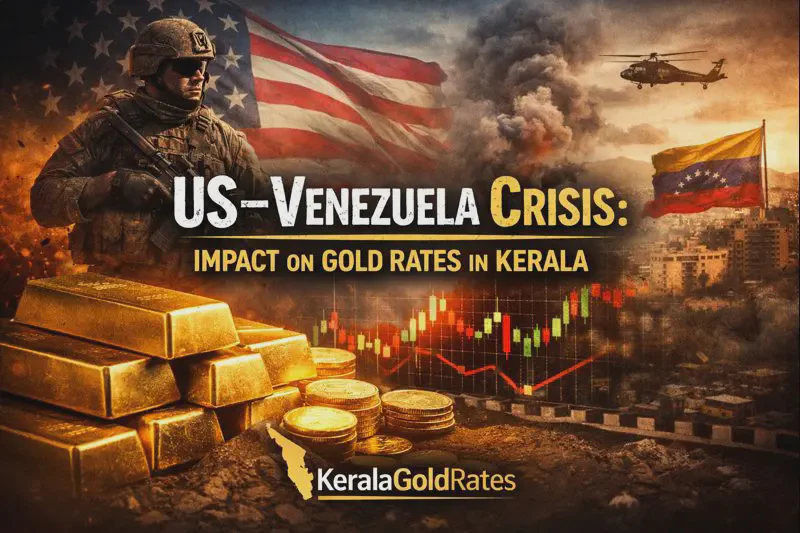
US–Venezuela Crisis: Impact on Gold Rates in Kerala
The financial world has been jolted by dramatic geopolitical news: U.S. forces conducted a controversial operation in Venezuela, capturing President Nicolás Maduro. This marked one of the most significant U.S. interventions in Latin America in decades. While the full economic repercussions will take time to unfold, the immediate ripple effects are already visible — especially in gold markets.
📈 Gold’s Safe-Haven Role Brightens Again
Gold is widely viewed as a “safe-haven” asset — a store of value investors turn to when geopolitical risks spike. The latest tensions involving Venezuela have reinforced this behavior:
Gold prices jumped sharply on the first trading day after the news — spot gold was up more than 2%, signaling increased buying on fear of uncertainty.
Precious metals such as silver have also surged, reflecting broader risk-hedging behavior by investors.
For gold buyers and investors in Kerala, this safe-haven demand could support higher gold rates in the short term, especially amid global risk aversion.
🧠 Why This Matters Even to Indian Markets
You might wonder: Why would an event in Venezuela affect gold rates in Kerala or India? Here’s how the chain can work:
Global uncertainty boosts gold demand: When investors fear political or economic instability, they buy gold as a hedge. That drives international gold prices higher.
Global benchmark prices influence local pricing: India — one of the world’s largest gold importers — sets its domestic prices based on the global spot price, exchange rates, and import duties. A surge in the international benchmark tends to translate into higher gold rates in Kerala and elsewhere.
Currency effects: A weaker US dollar often accompanies safe-haven buying, which makes gold cheaper for other currency holders — but the geopolitical premium can overshadow this benefit.
🛢️ A Wild Card: Oil & Market Psychology
Geopolitical conflict in Venezuela — a major oil reserve holder — has governments and markets contemplating possible disruptions to energy supplies. While Venezuela currently contributes only a small share to global output, fears of broader instability can push commodities like oil and gold in tandem.
However, analysts also point out that markets have been surprisingly calm so far, with equity and commodity moves being modest in some segments, suggesting that investors may be underestimating systemic risk.
📊 Short-Term Outlook (Next 1–4 Weeks)
Bullish pressure on gold:
- Continued safe-haven buying if geopolitical tension escalates.
- Short-term traders may push prices higher on volatility and risk-off sentiment.
Volatility expected:
- As data releases from major economies (e.g., US jobs or inflation) coincide with geopolitical headlines, gold markets could swing sharply.
Watch out for reversals:
- If the conflict stabilizes or markets take the news in stride, gold could see profit-taking declines, especially given already strong gains in 2025.
📅 Medium-Term Speculation (3–6 Months)
- Sustained higher average prices compared to pre-crisis levels are possible if geopolitical risk persists.
- Central banks, especially in Asia, could continue accumulating gold as a reserve diversification strategy, adding structural support to prices.
🏁 What It Means for Gold Buyers in Kerala
If you’re thinking of buying gold in the coming weeks:
- Expect higher premiums — international spot price pressures often feed into local rates.
- Timing matters: Political headlines can trigger sharp intraday moves, so avoid panic buying on volatile days.
- Long-term accumulation might still make sense if global uncertainty becomes entrenched.
Summary: Geopolitical risk from the US–Venezuela crisis has rekindled safe-haven demand for gold, nudging prices upward in global markets. For Kerala buyers, this translates into the possibility of higher gold rates in the near term — but volatility and broader macroeconomic forces will continue shaping the trend.
1 GM 24K (999.9+) Pure Gold Coin - Rose Design
This 1 gram 24K (999.9+) pure gold coin features an elegant rose motif and is minted by a certified refinery. Ideal for gifting, small investments, or conversion into jewellery, it comes with assured purity and buyback support as per seller terms.
- ✔ Individually numbered CertiCard
- ✔ Assured buyback at live market price
- ✔ BIS & LBMA certified purity
- ✔ Ideal for gifting & small investments
As an Amazon Associate, we may earn a commission from qualifying purchases without any additional cost to you.
Related Articles
Will US–Iran War Push Gold Prices Higher in Kerala?
Geopolitical tensions in the Middle East are once again making global headlines, with rising …
Read more →
Digital Gold in India: Is It a Smart Way to Invest in Gold Today?
In our previous post, we explored the various ways to invest in gold—from jewellery and coins to …
Read more →
Gold May Cross $5,000: Is ₹15,000 per Gram Next for Kerala 22K Gold?
Gold prices are once again in the spotlight. Global markets are increasingly discussing the …
Read more →